Key Highlights
- By the third trimester, your baby’s auditory system is fully functional and processing sound.
- The dominant background noise is your heartbeat, acting as a constant rhythmic metronome.
- Babies form auditory memories in the womb, recognizing specific stories and songs.
- Your voice is transmitted via bone conduction, making it the clearest sound they hear.
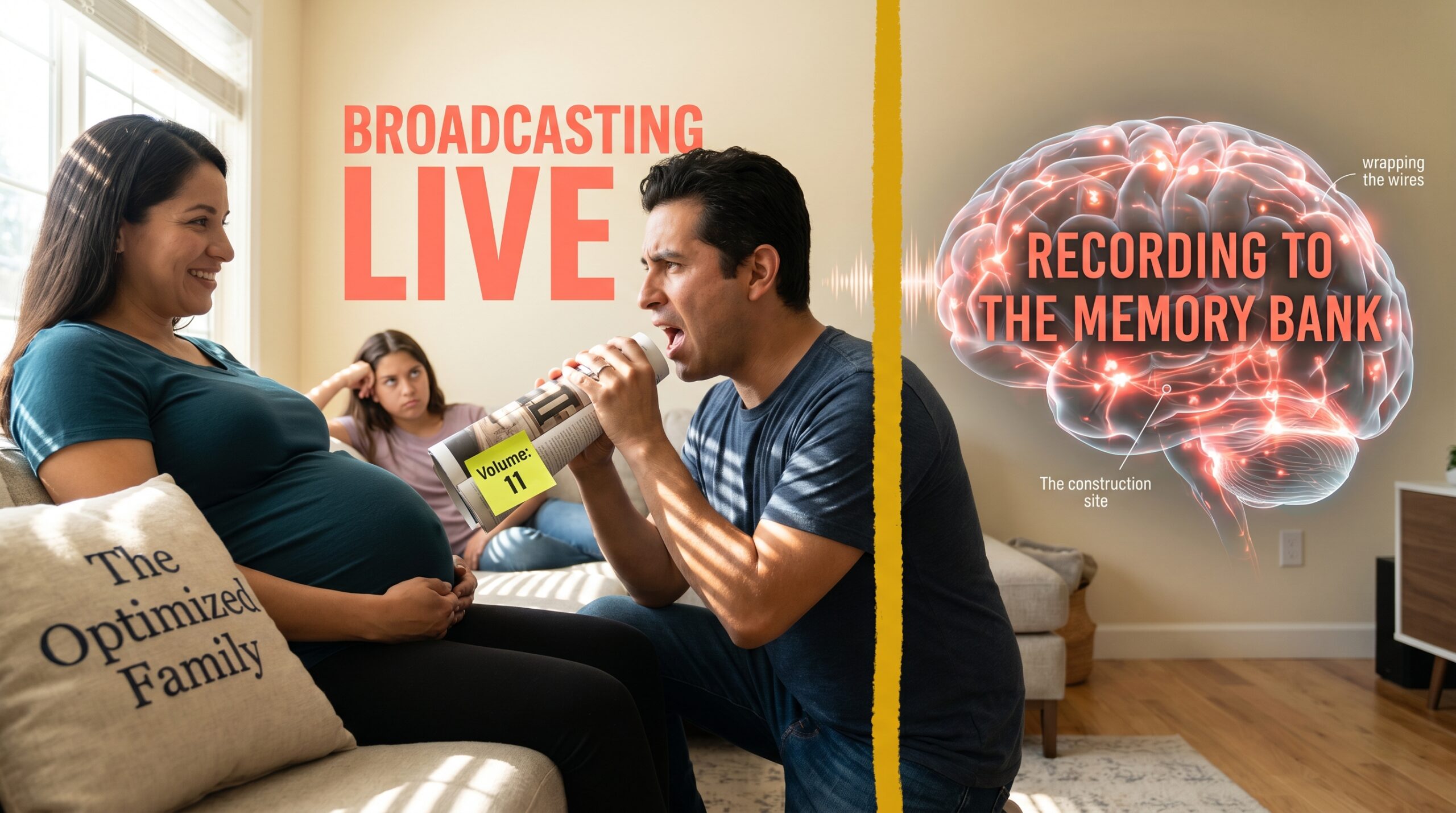
- Partners can build neural recognition pathways by talking to the belly daily.
- External noises like dogs barking prepare them for the chaotic outside world.
We do the research. You do the parenting.
The Moment You First Notice
You first notice your baby’s hearing when a sudden loud noise, like a dropped pan or a barking dog, causes a visible startle reflex in your belly. By the third trimester, their auditory system is fully online, meaning they are actively listening to the chaotic soundtrack of your daily life.
It usually happens when you least expect it. You accidentally slam a kitchen cabinet, and your abdomen physically jumps. That is not a coincidence. Your baby is no longer just floating in silence; they have front-row tickets to the acoustic concert of your life. The fluid-filled amniotic sac is not a soundproof bunker. It is a highly conductive acoustic chamber, and your baby is picking up everything from the dog barking at the mail carrier to the internal symphony of your digestive tract.

The Thing Your Baby Is Doing
Your baby is constantly processing a rich internal soundscape of your heartbeat, digestive gurgles, and blood rushing through uterine arteries. They are also picking up external sounds, filtering voices, and actively forming auditory memories that will help them recognize you immediately after they are born.
The womb is surprisingly loud. According to research published by the American Academy of Pediatrics, the background noise inside the uterus hovers around 70 to 90 decibels, which is roughly equivalent to the hum of a lawnmower or a busy highway. Your baby is floating in a rhythmic, noisy environment where your heartbeat acts as a massive, constant bass drum.
| Sound Source | What It Sounds Like Inside | Baby’s Reaction |
|---|---|---|
| Mother’s Heartbeat | A constant, rhythmic bass drum | Baseline comfort and security |
| Digestion | An underwater thunderstorm | Gentle swaying or indifference |
| Mother’s Voice | Booming surround sound | Measurable physiological calming |
| Dropped Pan | Distant cannon fire | Full body startle reflex |

Why Babies Do This At This Age
Babies develop this advanced hearing in the third trimester to build critical neural pathways for language and attachment. Recognizing your voice and the specific cadences of your household prepares their nervous system for life outside, allowing them to find comfort in familiar sounds immediately after birth.
The physics of fetal hearing is a marvel of biological engineering. Your voice is the dominant sound in their world because it reaches them through two distinct pathways simultaneously.
- The sound waves travel externally through the air and penetrate your abdominal wall.
- The vibrations travel internally down your spinal column and through your pelvic bones.
- The bone conduction amplifies the sound directly into the amniotic fluid.
Because of this dual-transmission system, research consistently shows that newborns preferentially turn toward their mother’s voice over a stranger’s voice within hours of birth Harvard Center on the Developing Child. Hearing your voice actually causes measurable physiological calming, reducing their heart rate and lowering cortisol levels.

Gentle Things You Can Try
You can actively engage your baby’s hearing by reading a specific book, playing a dedicated playlist, or having your partner speak directly to your belly. These repetitive audio cues build fetal auditory memory, giving you a powerful, familiar tool to calm them during those chaotic early newborn days.
A groundbreaking study demonstrated that newborns could distinguish a story read aloud repeatedly during the third trimester from one they had never heard, proving that fetal auditory memory is formed before birth Centers for Disease Control and Prevention. You can use this science to your advantage.
- Pick one specific, rhythmic book to read every night.
- Have your partner talk about their day near your abdomen.
- Play a specific chill-out song while you relax on the couch.
- Let the dog bark normally so the baby learns it is just background noise.
By doing this, you are essentially pre-installing a soothing button for the fourth trimester.
When To Call Your Pediatrician
You should contact your provider if you notice a complete and sudden cessation of fetal movement following loud noises or during your normal daily routine. While hearing development is standard, any drastic change in your baby’s baseline movement patterns warrants an immediate call to your provider to ensure everything is progressing safely.
We do not mess around with a lack of movement. If you ever feel like your baby’s activity levels have dropped off a cliff, do not rely on the internet. Call your provider, go in for a quick monitor check, and let the professionals work with you to ensure everything is perfectly fine. It is always better to be the parent who called over nothing than the parent who waited too long.
The Questions You would Google at 2 AM
When you are lying awake at 2 AM wondering if you accidentally deafened your unborn child by attending a loud movie, your brain will spiral into strange places. Here are the answers to the frantic searches you are typing into your phone in the dark to find some peace.
(Note: The actual Q&A pairs are handled by our backend system, but rest assured, your baby is fine and you do not need to whisper in your own house).
- Select Consistent Audio: Select a dedicated calming song or short rhythmic story to use every single day during your third trimester.
- Engage Your Partner: Have your partner speak directly toward your abdomen at a normal, conversational volume to build neural recognition.
- Normalize Household Noise: Expose your belly to normal household noises like the vacuum or dog barks to build acoustic tolerance.
- Build Association: Play the selected song whenever you are resting on the couch to associate the sound with physical calm.
We do the research. You do the parenting.
Stop guessing at 2 AM. Get the visual playbook.
80+ peer-reviewed studies translated into visual shortcuts you can actually use, one-handed, with a baby attached to you.

Frequently Asked Questions
Is my baby bothered by loud noises like dogs barking?
Your baby is well-insulated by amniotic fluid, which muffles sharp external noises. While a sudden dog bark might cause a startle reflex, it is not harming their hearing. Normal household chaos actually helps them acclimate to the real world before they even arrive.
Can my baby hear my partner’s voice through the belly?
Yes, your partner’s voice penetrates the abdominal wall, especially if they speak in lower registers. Regular talking, reading, or singing builds a neural recognition pathway, allowing your baby to recognize and find comfort in your partner’s voice immediately after birth.
Should I put headphones directly on my stomach?
You should avoid placing headphones directly on your belly. Amniotic fluid amplifies sound waves, and direct application can make the volume uncomfortably loud for the baby. Simply playing music out loud in the room at a normal volume is perfectly sufficient.
Why does my baby jump when I drop something?
When you drop a pan, the sudden acoustic spike penetrates the uterus and triggers your baby’s startle reflex. This is a completely normal neurological response indicating that their auditory system is fully functional and actively processing sudden changes in their environment.
Does reading the same book actually do anything?
Reading the same book repeatedly forms fetal auditory memory. Studies show newborns can distinguish a familiar story from an unknown one. Doing this provides you with a built-in soothing tool to help calm your baby during those intense early newborn days.