
Key Highlights
- Kick counting apps are excellent tools for tracking daily fetal movement trends.
- Your phone cannot evaluate your baby or replace your provider’s clinical judgment.
- Random movement during the day does not replace a dedicated counting session.
- Every baby has a unique baseline pattern that you should learn to recognize.
- Comparing your app data to another parent’s data will only cause unnecessary panic.
- If you notice decreased movement, bypass the app and call your provider immediately.
We do the research. You do the parenting. You are staring at a glowing screen at 2 AM, tapping a cartoon foot icon every time you think you feel a flutter. Welcome to the third trimester.
The Part Nobody Prepared You For
The anxiety of monitoring fetal movement is an unexpected mental marathon. While smartphone apps offer a convenient way to log data, they often create a false sense of security or unnecessary panic. You are suddenly tasked with being a data analyst for a roommate you have never met.
You thought the third trimester would be about folding tiny onesies. Instead, it is about lying perfectly still, holding your breath, and wondering if that was a kick or just the burrito you ate for dinner. Apps like Count the Kicks or Baby Kicks Monitor are incredibly popular. According to the American College of Obstetricians and Gynecologists, monitoring fetal movement is a standard recommendation in the third trimester Source. But these apps are just digital notebooks. They cannot reassure you that everything is fine.
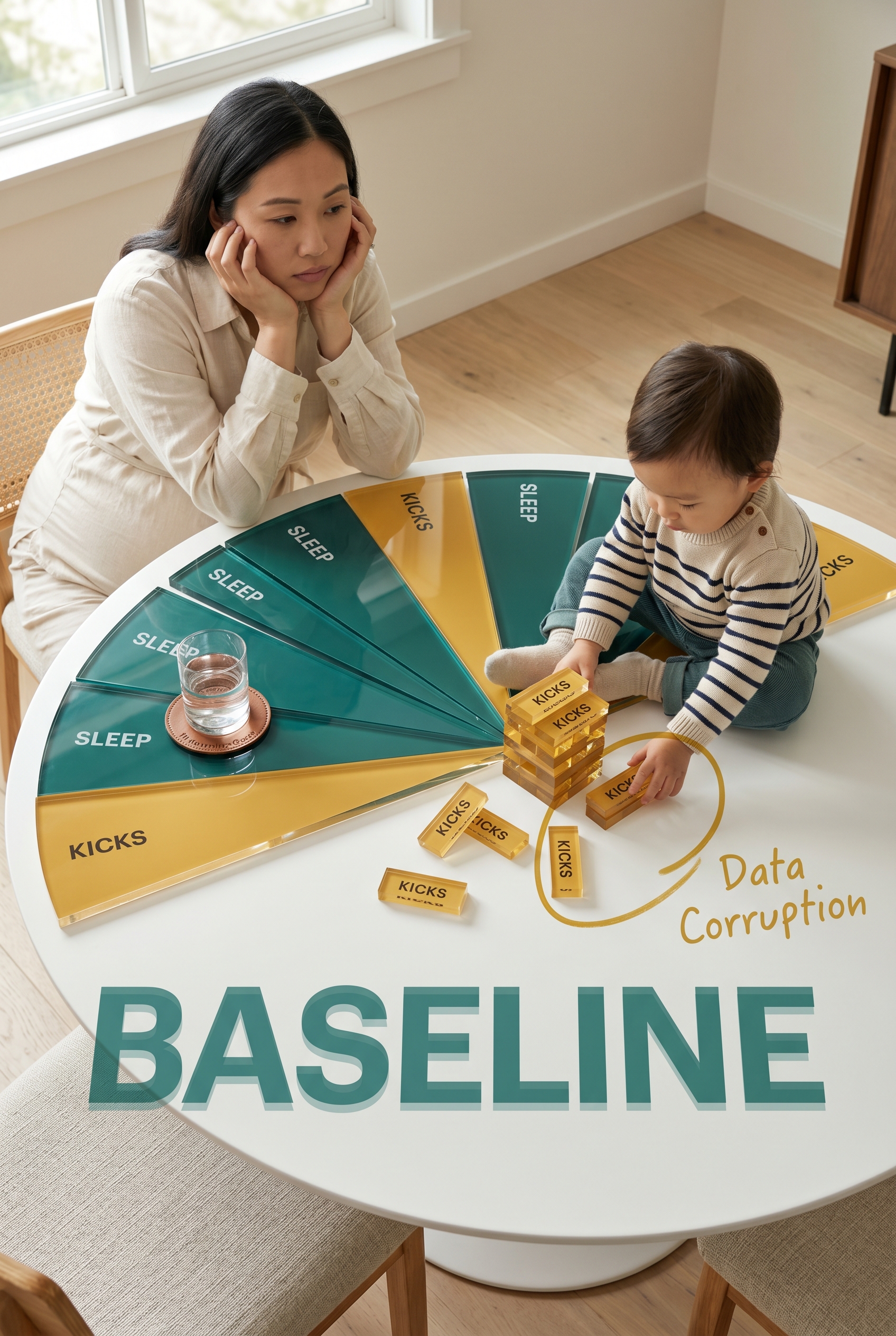
What Your Baby Is Actually Doing
Your baby is developing a distinct, individualized routine of sleeping and waking inside the womb. They are not following a textbook schedule, but rather establishing their own baseline of rolls, jabs, and flutters. The goal is to identify their unique normal, not to match an arbitrary external standard.
Babies are not machines. Some are aspiring kickboxers who practice their roundhouses at 3 AM. Others are gentle rollers who prefer to stretch lazily after you drink a glass of ice water.
Here is what actually matters:
- Finding their specific normal pattern.
- Noticing deviations from their established normal.
- Ignoring the mom on the internet whose baby apparently kicks four hundred times an hour.
Research from the National Institutes of Health indicates that recognizing a change in your specific baby’s movement pattern is the most critical factor in fetal monitoring Source. Do not compare your app data to anyone else’s. It is a useless metric that only breeds stress.

The Emotional Weight Of It
Staring at a kick-counting app can quickly spiral into an obsessive cycle of hyper-vigilance. The pressure to perfectly record every movement places a massive emotional burden on parents, turning a natural biological process into a high-stakes data entry job that ruins your ability to rest.
It is exhausting. You might feel a random jab while paying for groceries and think, “I should log that.” But a random jab does not replace a dedicated session.
Let’s look at the reality of tracking:
- You lie down to count.
- The baby immediately goes to sleep.
- You poke your belly, panic, and drink an entire glass of orange juice.
- The baby does a backflip.
- You finally sleep, only to repeat the cycle tomorrow.

What Helps (When The App Feels Like A Trap)
To ease the anxiety of tracking, use the app strictly as a recording tool during a dedicated daily window, rather than a 24/7 surveillance system. Establish a consistent time when your baby is typically active, log the session, and then close the application for the rest of the day.
The app is a fancy stopwatch. That is it. It cannot give you answers. It cannot evaluate the situation. It is just a place to put numbers.
| What The App Can Do | What The App CANNOT Do |
|---|---|
| Store your daily timeline | Tell you if the baby is safe |
| Show you a weekly trend | Replace a medical evaluation |
| Help you remember the data | Give you permission to ignore your gut |
- Find a quiet environment: Lie on your side in a quiet room, free from distractions, so you can focus entirely on your baby’s movements.
- Drink something cold or sweet: Consume a cold beverage or a small snack to help wake the baby up before you begin your dedicated counting session.
- Log the movements: Tap the app every time you feel a kick, roll, or flutter until you reach ten distinct movements.
- Review the time taken: Note how long it took to reach ten movements and compare it to your baby’s typical baseline pattern.
Red Flags That Cannot Wait
If you notice a significant decrease in your baby’s movement or a sudden deviation from their established baseline, bypass the app entirely and call your provider immediately. These changes warrant a prompt professional evaluation at labor and delivery to ensure everything is progressing safely.
We cannot stress this enough. If you feel that something is wrong, do not wait to see if the app’s chart looks better tomorrow. Go get checked.
Signs that warrant an immediate call:
- Failing to feel ten movements within two hours during a dedicated session.
- A sudden, drastic change in the type or strength of movements.
- Your intuition telling you something is off, regardless of what the screen says.
Your phone is smart, but it does not have a medical degree. You do the parenting, and part of parenting is asking for help when the data just does not feel right.
Questions Parents Actually Ask
Parents frequently question the accuracy of kick-counting apps, the best time of day to log movements, and whether hiccups count as kicks. Understanding the practical mechanics of fetal monitoring helps reduce late-night anxiety and clarifies when to seek professional guidance instead of relying on a screen.
We do the research. You do the parenting.
Stop guessing at 2 AM. Get the visual playbook.
80+ peer-reviewed studies translated into visual shortcuts you can actually use, one-handed, with a baby attached to you.

Frequently Asked Questions
Do baby hiccups count as movements in the app?
No, rhythmic hiccups do not count toward your daily kick goal. You are looking for distinct, deliberate movements like rolls, jabs, kicks, and flutters. If your baby has the hiccups, enjoy the strange sensation, but wait for actual kicks to log your data.
What is the best time of day to use a kick counter?
The ideal time is when your baby is typically most active, which is often in the evening or after you have eaten a meal. Consistency is key, so try to perform your dedicated monitoring session at roughly the same time every single day.
Can an anterior placenta make it harder to use the app?
Yes, an anterior placenta acts like a cushion at the front of your uterus, which can muffle the sensation of smaller movements. You will still feel your baby, but it might take longer to register distinct kicks, making patience during your session incredibly important.
Should I be worried if my baby’s pattern changes slightly?
Minor daily variations are normal, as babies have sleep cycles just like we do. However, a significant or sudden decrease from their established baseline warrants an immediate call to your provider. Never rely on an app to reassure you if your instincts say otherwise.
Is it safe to stop tracking if I feel movement all day?
Feeling random movements is great, but it does not replace a focused monitoring session. Taking time to sit quietly and track a specific window helps you truly understand the baseline. Casual observation often misses subtle shifts in activity that a dedicated session would catch.